


The amount of investing ideas in today’s world is plentiful. With this constant news flow and advertising through various forms of digital content, as well as easier access to a variety of investment products, it is important to be careful. There are many investing ideas or products that may appear very attractive. However, it is important to understand what you are getting yourself into before buying investments that seem so appealing on the surface. Two things that are important to better understand in aiding investment decisions are (1) how leveraged funds can work and (2) how high yields don’t always tell the whole story.
LEVERAGED FUNDS
Investopedia explains that a leveraged fund “is a security that uses financial derivatives and debt to amplify the returns of an underlying index or other assets it tracks.” There are even inverse leveraged funds that bet on the other side of the trade.
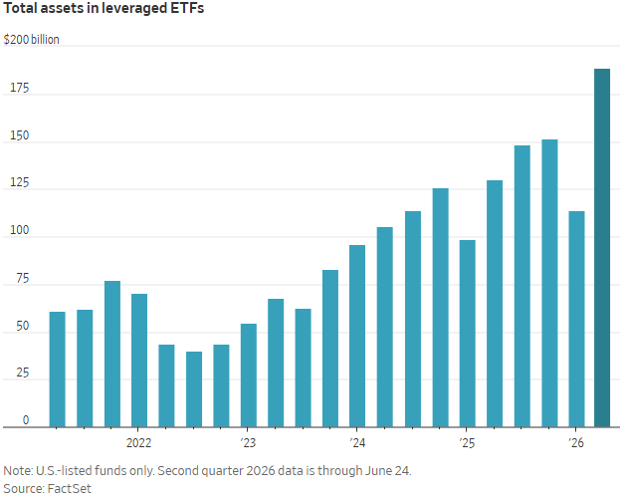
The quantity of investment products using leverage has skyrocketed recently. Last month, Spencer Jakab of theWall Street Journalwrote about these leveraged funds: “Leveraged ETFs’ assets have doubled in the past two months, according to Goldman Sachs. There are now more of these funds in the U.S. alone than there are companies in the S&P 500. Unlike stocks or normal funds, though, these are no buy-and-hold investments…
Of the 10 most-traded funds on the U.S. market over the past month,according to ETF Database, nine are leveraged or inverse products.”
A simple example of a leveraged fund is a 2x S&P 500 fund, which is designed to double the return of the S&P 500 every day, whether it’s positive or negative. What people don’t often internalize is that most of these products are designed to amplify the dailyreturns of their underlying index or stock, not the returns over a longer period. So if the S&P 500 is up 10% one year, that does not mean the leveraged fund will be up 20% during that same time period. And if the S&P 500 is down 5% one year, that does not mean the leveraged fund will be down 10% during that same time period. The returns on the leveraged fund could becompletelydifferent because the leverage on adailybasis can lead to massive gaps between the underlying index/stock and the leveraged product.
Jack Pitcher wrote about this in theWall Street Journallast year: “The brutal divergence in performance is caused by what traders call ‘volatility decay,’ or the tendency of price fluctuations to erode the long-term returns of a leveraged fund, even if the underlying asset goes up. And it is why leveraged-fund managers are quick to warn that their funds shouldn’t be held for long periods…
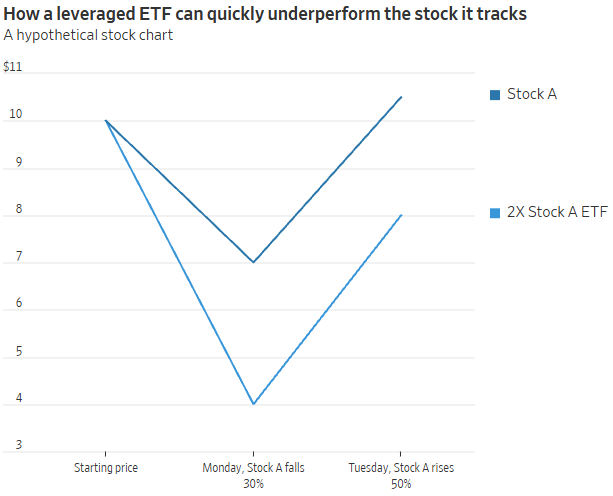
Take a hypothetical stock and a 2x daily leveraged ETF that tracks it, for example. Imagine both the stock and the leveraged fund begin the week with a share price of $10. If the shares fall 30% on Monday, the 2x ETF tracking them will fall 60% to close at $4.
If the stock roars back with a 50% gain on Tuesday, it is now up on the week, trading at $10.50. But even though the 2x ETF would have doubled the shares’ Tuesday performance, rising 100%, the ETF is only back to $8, and is now trailing its underlying asset on the week [see chart below from article].
The more volatile the asset, the more the leveraged ETF can diverge from its performance. And the harder it is for investors to climb back from steep losses.”
Although this example is extreme, it illustrates an important point - leverage works in both directions, and it can be devastating on the downside. We’ve looked at an example of a 2x fund, but there are also plenty of 3x funds out there, which would be even more dangerous on the downside. Pitcher recently identified an example from Direxion’s 3X Bull Semiconductor ETF: “On June 5, for example, the popular 3X semiconductor fund plunged 31% in a single session, roughly tripling its benchmark index’s decline, as intended.”
So when you think that an investment will go up over a long period of time, it may be tempting to try to use a leveraged fund to “double” or “triple” your returns. But it is vital to remember that using a leveraged fund on it will probably end up giving you a very different result than you might anticipate due to the aforementioned “volatility decay.”
THE POTENTIAL RISK OF HIGH YIELDS
People gravitate to “high yields” on investment products or individual stocks all the time without recognizing the risks and understanding the full picture. There are two components to an investment’s total return: price change and income received (via dividends/interest).
When people are drawn to products or stocks with “high yields,” they might only be focusing on one component of the investment’s return (the income). If a fund pays income of 10% in a given year, but its price goes down by 10% in that same time period, then there is basically no change in the overall return. So it’s vital not to get too attracted to promises of “high yields,” because those usually can only be generated with a trade-off somewhere else.
A very high yield on an individual stock can also potentially be a sign of risk or problems. For example, if a stock is trading at $100 per share and pays $2 of dividends per year, then its dividend yield would be 2%. But if the stock drops 50% to $50 per share, and the dividend stays at $2 per year, the dividend yield is now at 4%. A 4% dividend yield sounds a lot better than a 2% dividend yield, but if a company’s stock price just lost half of its value, it’s likely there are many concerns and risks with that company.
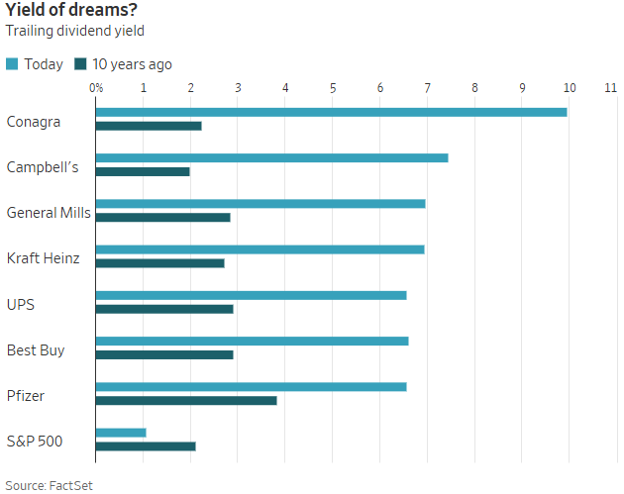
Earlier this year on a May 7, 2026 morning newsletter, Spencer Jakab of theWall Street Journalwrote: “Eye-catching yields are often a sign of strain, which is why stocks that pay high, but not the highest, dividends have tended to perform better over time.
And total return is what matters. Even with all those dividends, an investment in General Mills, Conagra, Campbell’s or Kraft Heinz would have returned negative 20%, 41%, 54% or 57%, respectively, over the past 10 years. The S&P 500, which had a mere 2.1% yield a decade ago, has returned 324% in total [see chart below from article].
Investor surveys show that many incorrectly view dividends as free money. Any cash paid out instantly reduces a company’s value, though.”
This brings up an important point to understand that an article from Fidelity helps explain: that “dividends do have a cost. A company cannot pay out dividends to shareholders without affecting its market value.
Think of your finances. If you constantly paid cash to family members, your net worth would decrease. It's no different for a company. Money that a company pays to shareholders is money that is no longer part of the asset base of the corporation. This money can no longer be used to reinvest and grow the company. That reduction in the company's ‘wealth’ has to be reflected in a downward adjustment in the stock price.
A stock price adjusts downward when a dividend is paid. The adjustment may not be easily observed amidst the daily price fluctuations of a typical stock, but the adjustment does happen.”
Something with an extremely high yield may be giving you a good amount of cash along the way, but the price of the asset may be dropping at the same time. The total return is what really matters.
BE CAREFUL OUT THERE
The marketing for these leveraged funds and assets with very high yields can be very enticing. But it doesn’t often tell the whole story. There are many things to understand about an investment outside of the positive highlights. It is important to seek to understand and recognize the risks and trade-offs before jumping into something that might seem too good to pass up.
Sources:
https://www.investopedia.com/terms/l/leveraged-etf.asp
https://www.fidelity.com/learning-center/investment-products/stocks/why-dividends-matter
Disclosures:
The opinions voiced in this material are for general information only and are not intended to provide specific advice or recommendations for any individual. All performance referenced is historical and is no guarantee of future results. All indices are unmanaged and may not be invested into directly.
Stock investing includes risks, including fluctuating prices and loss of principal.
There is no guarantee that a diversified portfolio will enhance overall returns or outperform a non-diversified portfolio. Diversification does not protect against market risk.